
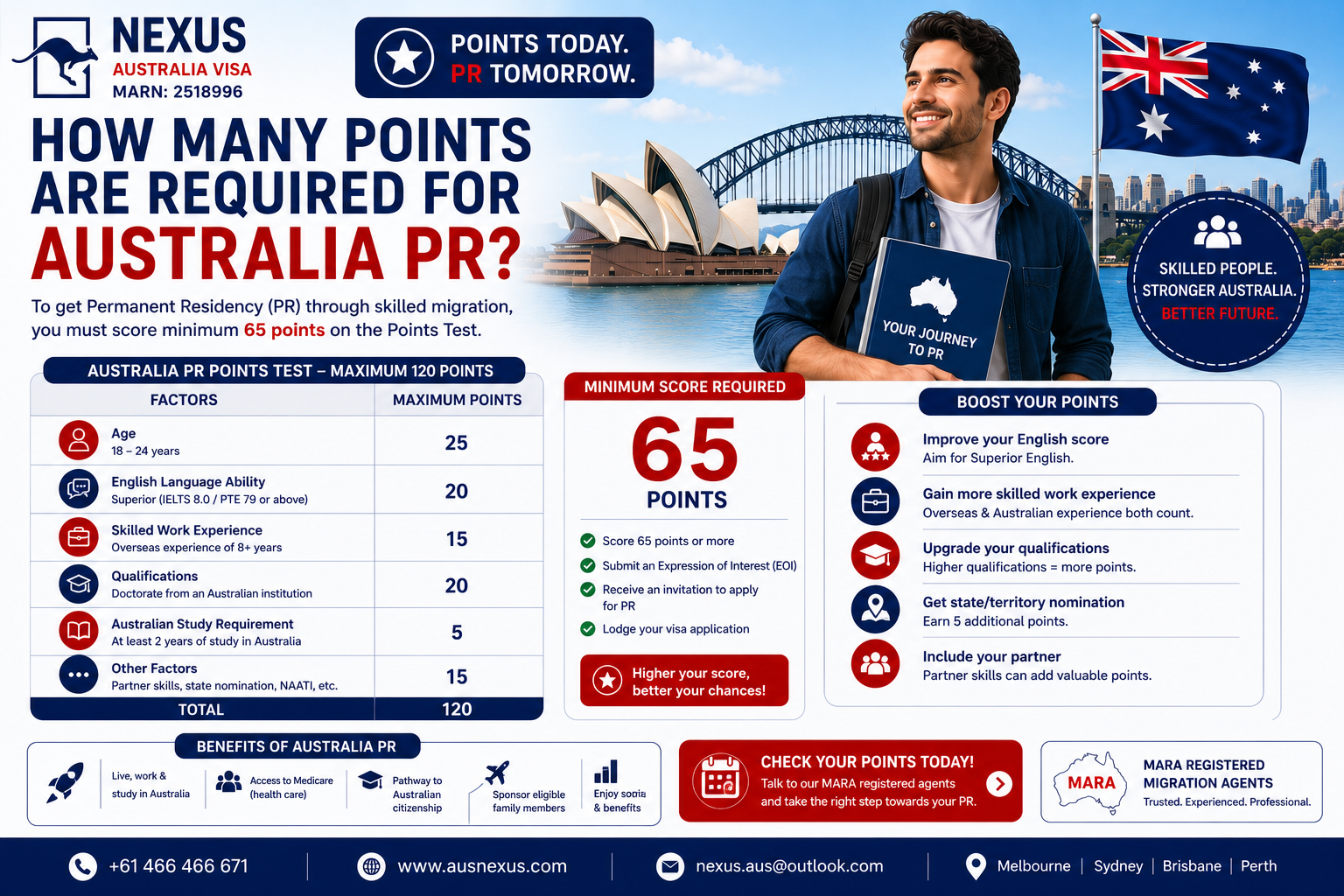
If you’ve been researching Australian Permanent Residency, you’ve likely come across the term “points test” more than once. And for good reason – Australia’s points-based immigration system is the backbone of its skilled migration program. But how many points do you actually need, and what does it take to be truly competitive in 2025?
The short answer is 65 points. But the real answer is far more nuanced than that. Let’s dive deep into everything you need to understand about Australia’s points system and how to make it work in your favour.
 Understanding Australia’s Points-Based Immigration System
Australia uses a points-based system to assess and rank skilled migration applicants under the General Skilled Migration (GSM) program. This system is designed to prioritise candidates who are most likely to contribute positively to the Australian economy and society. It’s not just about meeting a number – it’s about demonstrating overall value through your skills, experience, and attributes.
The points test applies to several key visa subclasses, including the Subclass 189 (Skilled Independent Visa), Subclass 190 (Skilled Nominated Visa), and Subclass 491 (Skilled Work Regional Visa). Understanding how each factor is scored gives you a powerful advantage when planning your migration pathway.
🎯 The Minimum Threshold – 65 Points to Enter, More to Win
The minimum points requirement to submit an Expression of Interest (EOI) through SkillSelect is 65 points. This threshold qualifies you to enter the pool of candidates but it certainly doesn’t guarantee you’ll receive an invitation to apply for PR. In 2025, the competition among skilled applicants remains high, and simply meeting the minimum is rarely enough to stand out.
In many occupation categories, applicants are being invited with scores of 80, 85, or even 90+ points. The higher your score, the better your chances of receiving an invitation during one of the monthly invitation rounds. Treating 65 as a target rather than a floor is one of the most common and costly mistakes aspiring migrants make.
📊 What Factors Earn You Points? A Full Breakdown
Understanding where your points come from is the key to building a competitive profile. Here’s a detailed look at every major scoring category under Australia’s skilled migration points test.
🎂 1. Age – Act While You’re Young
Age is one of the most significant point contributors in the Australian points system, rewarding younger applicants who are seen as long-term contributors to the workforce. Points are awarded as follows across different age brackets.
- 18–24 years: 25 points
- 25–32 years: 30 points (maximum)
- 33–39 years: 25 points
- 40–44 years: 15 points
- 45 years and above: 0 points (ineligible for most skilled visas)
The message here is crystal clear – the earlier you start your Australian PR journey, the more points you naturally earn just by being young. Every year you delay could mean fewer points and a harder road ahead.
🗣️ 2. English Language Proficiency – More Than Just Communication
Your English language ability directly impacts your points score and your overall competitiveness as a skilled migrant. Scores are awarded based on your performance in recognised tests such as IELTS, PTE Academic, TOEFL iBT, or OET.
- Competent English (IELTS 6.0 in each band): 0 bonus points (but mandatory minimum)
- Proficient English (IELTS 7.0 in each band): 10 points
- Superior English (IELTS 8.0 in each band): 20 points
Investing time and preparation into achieving a higher English test score is one of the fastest and most accessible ways to significantly boost your points total. Many applicants underestimate the impact of going from competent to proficient or proficient to superior.
💼 3. Skilled Work Experience – Your Career Pays Off
Australia rewards applicants who bring real, demonstrated work experience in their nominated skilled occupation. Points are awarded for both overseas and Australian work experience, with Australian experience generally earning more.
Overseas work experience:
- 3–4 years: 5 points
- 5–7 years: 10 points
- 8+ years: 15 points
Australian work experience:
- 1–2 years: 5 points
- 3–4 years: 10 points
- 5–7 years: 15 points
- 8+ years: 20 points
Having significant Australian work experience can dramatically increase your score. If you’re already working in Australia on a temporary visa, every additional year you spend in a skilled role is actively building your PR score.
🎓 4. Educational Qualifications – Credentials That Count
Your formal educational background earns you points based on the level and relevance of your qualifications. Whether you hold a doctorate, a bachelor’s degree, or a diploma, Australia’s points system recognises your academic investment.
- Doctorate (PhD): 20 points
- Bachelor’s degree or higher (not PhD): 15 points
- Diploma or trade qualification: 10 points
- Award from an Australian educational institution (studied while in Australia): Additional 5 points
If you studied in Australia, you gain a bonus 5 points on top of your qualification points – making local study a genuinely strategic investment for long-term PR goals.
🏛️ 5. State or Territory Nomination – A Powerful Booster
Receiving state or territory nomination is one of the most impactful ways to increase your points score and fast-track your PR pathway. Nomination from a state or territory government under the Subclass 190 visa adds 5 points to your total, while the regional Subclass 491 adds a significant 15 points.
Beyond the points boost, state nomination also signals to immigration authorities that a specific region of Australia has identified you as a skilled worker they want to attract. Meeting a state’s individual nomination criteria which may include residency commitments or occupation-specific requirements is essential to securing this powerful advantage.
🌾 6. Regional Study in Australia – Rewarding Those Who Go Beyond the Cities
If you completed at least one year of study at an eligible educational institution in a regional area of Australia, you can earn an additional 5 bonus points. This incentive is part of Australia’s broader strategy to encourage skilled migrants and international graduates to settle outside major metropolitan centres like Sydney and Melbourne.
Regional study points are separate from your qualification points, meaning they stack together to strengthen your overall profile. For international students who studied in regional campuses or towns, this is an often-overlooked opportunity to gain a meaningful advantage in the points race.
👫 7. Partner Skills – Teamwork Makes the Dream Work
If your partner or spouse is also a skilled migrant who has completed a skills assessment and meets the English language requirements, you can earn an additional 10 points toward your total. This makes applying as a skilled couple an incredibly strategic advantage in the Australian points system.
Alternatively, if you are single or your partner is an Australian citizen or permanent resident, you may also be eligible to claim 10 points under partner status criteria. This is a points opportunity that many applicants overlook but can make a decisive difference in competitive invitation rounds.
🎓 8. Professional Year in Australia – For International Graduates
Completing an accredited Professional Year Program in Australia in the fields of accounting, IT, or engineering can earn you an additional 5 points. This structured program combines formal training with a workplace internship and is specifically designed to bridge the gap between your overseas qualifications and Australian professional standards.
For international graduates already based in Australia, completing a Professional Year is a smart double win you gain Australian workplace experience AND valuable migration points simultaneously. It’s a commitment that genuinely pays dividends on your PR journey.
🔢 What Does a Competitive Points Score Look Like in 2025?
To give you a realistic picture, here’s a sample profile of a competitive applicant in 2025. This is a 28-year-old IT professional with a bachelor’s degree, 5 years of overseas experience, 2 years of Australian experience, proficient English, and state nomination under Subclass 190.
| Factor | Points |
|---|---|
| Age (25–32) | 30 |
| Proficient English | 10 |
| Overseas work experience (5–7 yrs) | 10 |
| Australian work experience (1–2 yrs) | 5 |
| Bachelor’s degree | 15 |
| State nomination (Subclass 190) | 5 |
| Total | 75 points |
This profile sits comfortably above the minimum and is competitive across many occupation categories. Adding partner skills, superior English, or a professional year could push this even higher.
💡 Tips to Maximise Your Australia PR Points Score
Building a strong points profile requires both planning and patience. Here are key strategies that can help you increase your score before lodging your Expression of Interest.
Retake your English test if you’re sitting at competent level moving to proficient adds 10 points and proficient to superior adds another 10. That’s 20 free points available through preparation and practice alone. Accumulate more Australian work experience before submitting your EOI, as Australian experience earns significantly more points than overseas experience. Consider state nomination strategically even if it requires living in a non-preferred state initially, the points boost can dramatically accelerate your PR timeline.
🌟 Final Thoughts – Let Nexus Australia Build Your Winning Points Strategy
Navigating Australia’s points test is both a science and a strategy. Knowing the minimum is just the starting point building a truly competitive profile requires careful analysis of your personal circumstances, smart timing, and expert guidance. Every factor counts, and every point matters.
That’s exactly where Nexus Australia becomes your greatest asset. As one of Australia’s most respected and results-driven immigration consultancies, led by registered MARA agent Mandeep Gill (MARN: 2518996), the Nexus Australia team specialises in building powerful, personalised migration strategies that maximise your points and fast-track your PR journey.
From skills assessments and EOI submissions to state nomination and employer sponsorship, Nexus Australia handles every step with professionalism, precision, and genuine care for your outcome. With a proven track record across thousands of successful visa cases and clients spanning multiple countries, Nexus Australia is the team you want in your corner.
Don’t leave your Australian PR to guesswork. Get expert advice today and discover exactly how many points you have and how to get more.
📞 Call: +61 466 466 671 🌐 Visit: ausnexus.com 📧 Email: visa@ausnexus.com
More points. Better chances. Brighter future – with Nexus Australia by your side.