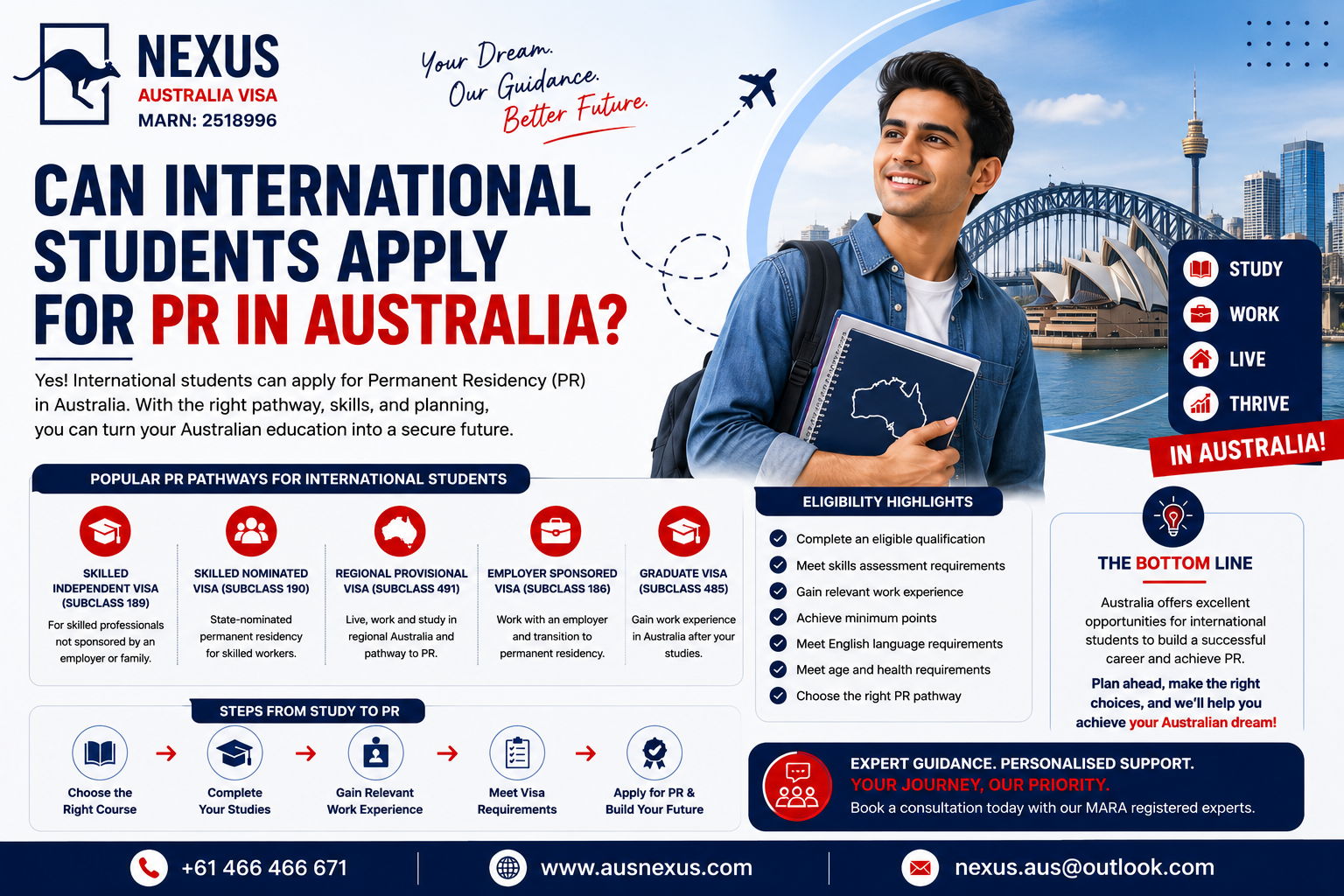
So you’ve spent the last few years studying in Australia. You’ve sat through exams, pulled late nights in the library, navigated a completely new culture, and built a life here that genuinely feels like home. And now the big question is sitting right in front of you can you actually stay? Can international students apply for PR in Australia?
The short answer is yes. But like most things in the Australian immigration world, the full answer has a few more layers to it. The good news is that Australia’s migration system genuinely does reward international graduates it’s one of the few countries in the world that actively builds pathways for students who’ve studied locally to transition into permanent residents.
Let’s walk through exactly how that works, what you need to have in place, and what the journey from graduation to PR actually looks like in practice.
Why Australia Wants Its International Graduates to Stay
Here’s something that surprises a lot of students: Australia doesn’t just tolerate international graduates sticking around it actively encourages it. The country has ongoing skill shortages across dozens of industries, and graduates who’ve already studied here, understand the culture, and meet Australian academic standards are genuinely valuable to the workforce.
The government recognises this, which is why there are specific visa pathways designed to bridge the gap between finishing your degree and securing permanent residency. These aren’t loopholes or workarounds they’re deliberate, structured parts of the immigration system built with international graduates in mind.
That said, the pathway isn’t automatic. Completing a degree in Australia doesn’t hand you a PR visa on graduation day. There are steps, requirements, and strategic decisions involved and understanding them early gives you a serious advantage over those who figure it out too late.
Step One – The Temporary Graduate Visa (Subclass 485)
For most international students, the first stop after graduation is the Temporary Graduate Visa, commonly known as the Subclass 485. This visa is essentially a bridge it gives you time to stay in Australia, work full-time, and build the experience and profile you’ll need to apply for PR.
The 485 visa has two main streams. The Post-Higher Education Work stream is for graduates who’ve completed a bachelor’s degree, masters, or doctorate at an Australian institution. The Post-Vocational Education Work stream covers graduates from eligible trade and vocational qualifications. The length of your visa depends on the level of study and where your institution was located regional study can earn you an extra year or two.
This is an incredibly valuable window of time, and how you use it matters enormously. The students who eventually land PR are typically the ones who treat their 485 visa period strategically building relevant work experience, improving their English scores, and getting their skills assessment sorted while they still have time on their side.
💡 Already on a 485 visa and not sure what your next step toward PR looks like? The team at Nexus Australia works with graduates every day to map out their clearest pathway to permanent residency. Led by MARA-registered agent Mandeep Gill (MARN: 2518996), Nexus offers a free initial case evaluation so you know exactly where you stand. Visit ausnexus.com or WhatsApp +61 466 466 671 to book yours today.
Step Two – Getting Your Skills Assessed
One of the most important and most commonly underestimated parts of the PR journey for international graduates is the skills assessment. Before you can submit an Expression of Interest for a skilled migration visa, you need a formal assessment confirming that your qualifications and work experience meet Australian professional standards for your nominated occupation.
Every occupation has a designated assessing authority. Engineers go through Engineers Australia. Accountants are assessed by bodies like CPA Australia or CAANZ. IT professionals go through the Australian Computer Society (ACS). Nurses and healthcare workers have their own specific authorities too. Each one has different documentation requirements, different processing timelines, and different standards so understanding what yours expects is genuinely important.
Many graduates make the mistake of assuming their Australian degree automatically satisfies the skills assessment. In most cases, it significantly strengthens your application but the formal assessment still needs to happen, and it still needs to be done correctly. Submitting incomplete or poorly structured evidence can lead to delays or a negative outcome that affects your entire PR timeline.
Step Three – Building Relevant Work Experience
Here’s the thing that no one really tells you when you’re still in your final semester: your degree alone won’t get you PR. What actually makes the difference in terms of both points and eligibility is relevant skilled work experience in your nominated occupation after graduation.
For most skilled visa pathways, you’ll need at least one year of relevant work experience, though more is better. And it needs to be genuine, skilled employment that matches your nominated occupation — not just any job you picked up to pay the rent during your studies. The quality and relevance of your work history is scrutinised carefully, so keeping proper records, maintaining good employment references, and working in roles that genuinely align with your skills assessment is critical.
This is also why the 485 visa period is so valuable. Use it to get into your field, build your experience, and document everything along the way. Every month of relevant skilled employment you clock up during this period is another step closer to the points and eligibility you need for PR.
Step Four – English Language Requirements
No matter what skilled visa you’re targeting, you’ll need to demonstrate your English proficiency through a recognised test IELTS, PTE Academic, TOEFL iBT, or OET are the most commonly accepted options. The minimum standard for most skilled visas is Competent English, which is roughly equivalent to an IELTS score of 6.0 in each component.
But here’s where it gets really interesting for PR purposes: higher English scores earn you extra migration points. Scoring at the Proficient English level (IELTS 7.0 overall) adds 10 points to your score. Reaching Superior English (IELTS 8.0 overall) adds 20 points. In a competitive points pool, that difference can literally determine whether you get an invitation this round or wait another 12 months.
Many international graduates who’ve studied entirely in English assume their score will be strong and often it is. But don’t assume. Sit the test, know your score, and if there’s room to improve, invest the time in preparation before you submit your Expression of Interest. It’s one of the highest-return things you can do for your migration outcome.
Step Five – Choosing the Right Occupation
This step catches a lot of graduates off guard. It’s not just about what you studied it’s about which specific occupation you nominate for migration purposes, and whether that occupation is actually in demand in Australia right now.
Australia publishes several occupation lists that determine which roles are eligible for skilled migration visas. These include the Medium and Long-term Strategic Skills List (MLTSSL) and various state-specific occupation lists. The occupation you choose must appear on the relevant list for your target visa, and demand for that occupation affects how competitive invitation rounds are.
Here’s the thing many degree programs cover multiple potential occupations, and sometimes one is far more strategically advantageous than another. Choosing the right occupation isn’t just an administrative decision. It’s a migration strategy decision, and getting it wrong can mean targeting a highly competitive occupation when a more accessible one was available to you all along.
💡 Nexus Australia specialises in exactly this kind of strategic decision-making. The team has helped dozens of international graduates identify the most advantageous occupation for their profile saving months of waiting and thousands of dollars in avoidable mistakes. Get in touch at ausnexus.com or call +61 466 466 671 for expert guidance tailored to your situation.
The Points Test – Where Everything Comes Together
Once you’ve got your skills assessment, your English score, and your work experience sorted, it’s time to look at your overall points score for the skilled migration points test. This is the system Australia uses to rank EOI applicants against each other in competitive invitation rounds.
Points are awarded across several categories. Here’s a simplified breakdown of what contributes to your total:
- Age – applicants aged 25 to 32 score the highest points, with progressively fewer points awarded as you move outside that range
- English proficiency – Competent, Proficient, and Superior levels each carry different values
- Skilled work experience – both Australian and overseas experience count, with Australian experience weighted higher
- Educational qualifications – doctorate, bachelor, and diploma-level qualifications each carry different point values
- Australian study – completing at least two academic years in Australia earns you additional points
- State or territory nomination – adds 5 points (or 15 for regional nomination)
- Regional study – studying in a regional institution can add further points
The minimum score to be eligible is 65 points, but in practice, most successful invitations go to applicants with 80 or above in competitive occupations. Knowing your exact score and understanding which areas you can realistically improve is where professional guidance becomes genuinely invaluable.
PR Visa Pathways for International Graduates
Once you’ve built your profile and submitted your EOI through SkillSelect, the pathway to PR typically runs through one of the following visa subclasses:
Subclass 189 (Skilled Independent) – this is the fully independent PR visa that doesn’t require a job offer or state nomination. It’s highly competitive, and you’ll need a strong points score and an occupation on the MLTSSL to be considered.
Subclass 190 (Skilled Nominated) – this visa requires nomination from an Australian state or territory government. It awards 5 additional points and can be significantly more accessible than the 189 for graduates in occupations that specific states are actively seeking.
Subclass 491 (Skilled Work Regional) – this is a temporary regional visa that leads to PR after two years of living and working in a designated regional area. It adds 15 points to your score and is often the fastest realistic pathway for graduates who don’t yet score high enough for the 189 or 190.
Employer-Sponsored Pathways – if you’ve secured employment in your field during your 485 visa, your employer may be willing to sponsor you for a Subclass 482 or 186 visa. This can be a strong pathway, particularly if your occupation isn’t well-represented on the standard skilled lists.
One Thing That Trips Up a Lot of Graduates
There’s a common assumption among international students that because they studied in Australia, they have a guaranteed advantage in the PR process. And while Australian study does earn you bonus points and can support your skills assessment, it doesn’t guarantee anything on its own.
PR is not automatic after graduation. It’s not even guaranteed after a 485 visa. Many graduates who didn’t plan strategically during their studies find themselves in a difficult position their visa is expiring, their occupation isn’t in demand, their English score isn’t high enough, or they simply don’t have enough relevant work experience yet.
The students who successfully transition to PR are almost always the ones who started thinking about it early ideally before they even finished their degree and made deliberate choices along the way about their occupation, their work experience, their English test preparation, and their state nomination strategy.
Is PR Harder to Get as a Graduate in 2025?
Competition for skilled migration invitations has increased in recent years, and that’s simply the reality of the current landscape. More people are applying, occupations move on and off the lists, and state nomination spots are limited. That said, Australia’s skill shortages remain significant particularly in healthcare, engineering, construction, education, and technology and genuine opportunities absolutely still exist for well-qualified graduates.
What’s changed is that flying blind through the process is increasingly costly. The graduates who succeed are the ones with a clear strategy, a strong profile, and expert guidance backing them up at every stage.
💡 Nexus Australia has helped international graduates from all over the world navigate the PR journey — from 485 visa planning right through to permanent residency lodgement. With offices in Adelaide, India, and Canada, the team is genuinely accessible no matter where you currently are in the world. MARA agent Mandeep Gill and the Nexus team bring a rare combination of migration law expertise and real human understanding to every case they handle. Visit ausnexus.com, email info@ausnexus.com, or WhatsApp +61 466 466 671 your first case evaluation is completely free.
Final Thoughts – Your PR Dream Is Achievable, But Plan for It
Yes, international students absolutely can apply for PR in Australia – and thousands do so successfully every year. But the ones who get there aren’t just lucky. They’re prepared. They understood the system, made the right choices during their study and 485 periods, and got proper guidance before making decisions that would shape their entire migration outcome.
If you’re still studying, start thinking about this now. If you’re already on a 485, don’t waste a single day of it. And if you’re feeling lost or overwhelmed by the options in front of you that’s exactly what experienced migration agents are here for.
Your permanent residency in Australia is possible. You just need the right map to get there.
Ready to take the next step? Speak with the team at Nexus Australia today. Call +61 466 466 671, WhatsApp “VISA”, or visit ausnexus.com to book your free case evaluation. Your future in Australia starts with one conversation.