
How Do I Apply for Skilled Migration to Australia? A Complete Step-by-Step Guide for 2026
If building a permanent life in Australia is your goal, understanding how to apply for skilled migration to Australia is the single most important starting point of your entire journey. The process involves multiple structured stages each with its own requirements, deadlines, and strategic decisions and getting any one of them wrong can cost you months of time and thousands of dollars.
Australia’s skilled migration system is points-based, competitive, and deliberately designed to attract the world’s most capable professionals. Whether you’re a nurse, engineer, IT specialist, accountant, or tradesperson, the pathway to Australian permanent residency follows a clear sequence of steps and knowing exactly what those steps are, in the right order, gives you an enormous advantage before you even begin. At Nexus Aus Visa, Adelaide’s trusted registered migration agency, we guide skilled migrants through every single stage of this process with precision, professionalism, and genuine care for your outcome.
Overview: How Does the Australian Skilled Migration Process Work?
Before diving into individual steps, it helps to understand the big picture of how Australia’s skilled migration system is structured. Unlike some countries that accept direct visa applications, Australia uses an invitation-based system for most skilled migration pathways meaning you must first express your interest and be formally invited before you can actually lodge a visa application.
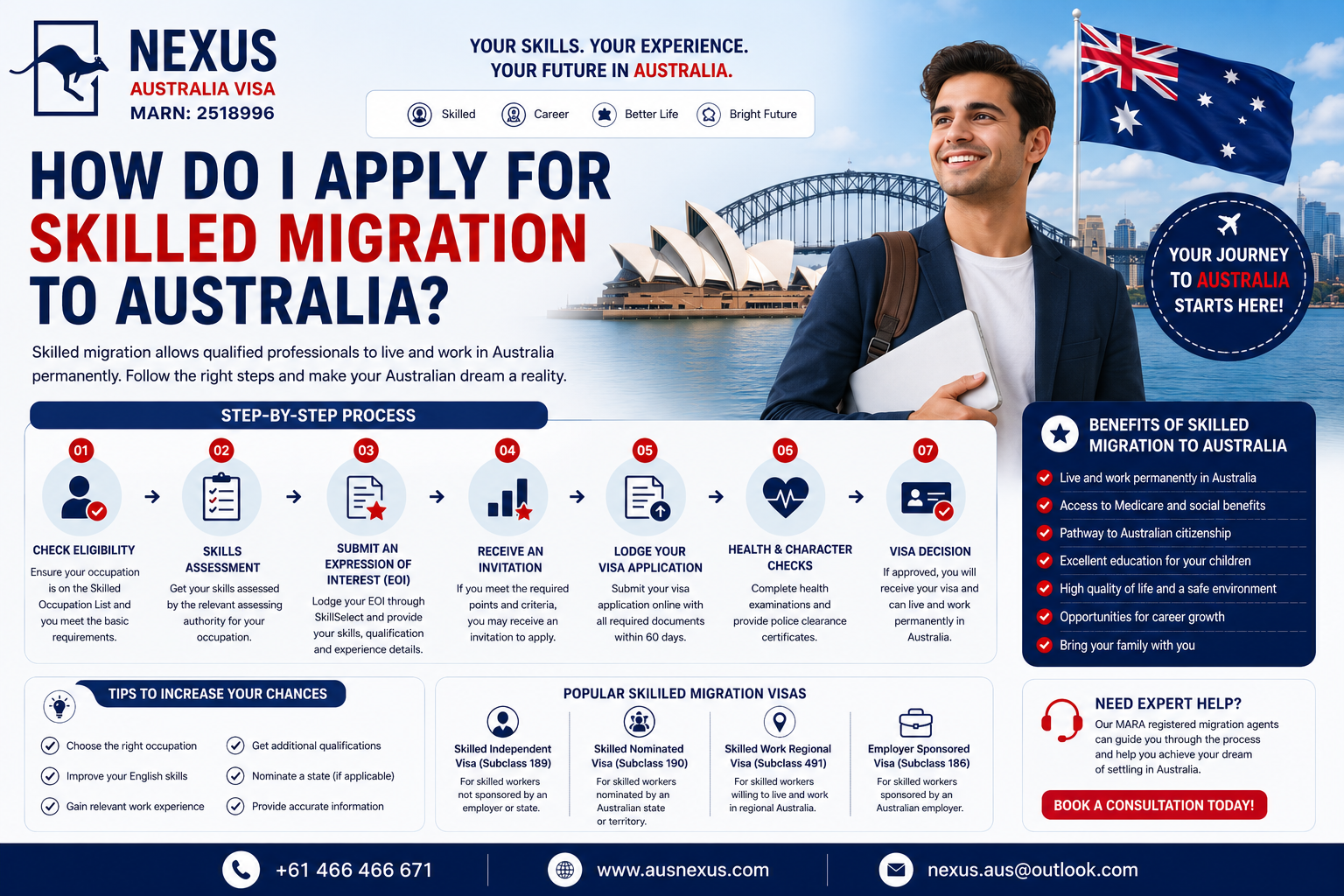
The entire skilled migration journey typically follows this sequence: skills assessment → English test → points calculation → Expression of Interest (EOI) submission → invitation → visa application lodgement → health and character checks → visa grant. Each stage feeds directly into the next, and delays or errors at any point in the chain can have significant downstream consequences. Understanding this flow from the outset is the foundation of a well-planned, successful migration strategy — exactly what the team at Nexus Aus Visa helps you build from day one.
Step 1: Determine Your Eligible Occupation and Visa Subclass
The very first action in your skilled migration journey is confirming that your occupation is eligible for Australian migration and identifying which visa subclass aligns best with your profile, goals, and circumstances. This step sounds simple but it carries enormous strategic weight.
Australia maintains several skilled occupation lists that determine which roles are eligible for each visa stream. These include the Medium and Long-term Strategic Skills List (MLTSSL), the Short-term Skilled Occupation List (STSOL), and various state-specific occupation lists used for regional and nominated visa streams. Your nominated occupation must appear on the relevant list for your chosen visa subclass and if you nominate the wrong one, your entire application can be invalidated.
At Nexus Aus Visa, our first consultation with every client includes a thorough occupation and visa subclass assessment ensuring you pursue the right pathway from the very beginning, rather than discovering a costly mismatch months down the line.
Step 2: Complete Your Skills Assessment
Once you’ve confirmed your eligible occupation and target visa subclass, the next critical step is obtaining a positive skills assessment from the relevant Australian assessing authority for your occupation. This assessment officially confirms that your qualifications and work experience meet Australian standards for your nominated role.
Every occupation has a designated assessing body for example, Engineers Australia assesses engineering professionals, VETASSESS covers a broad range of professional and trades occupations, AITSL handles teaching professionals, and AHPRA governs healthcare practitioners. The assessment process typically requires certified copies of your qualifications, detailed employment references, and in some cases, professional portfolios or competency demonstrations.
Skills assessment timelines vary significantly between assessing bodies some take as little as four weeks while others can take four to six months or longer during peak demand periods. At Nexus Aus Visa, we help clients prepare skills assessment applications that are complete, correctly formatted, and strategically presented reducing the risk of delays, additional information requests, or unfavourable outcomes.
Step 3: Sit Your English Language Test and Achieve Your Target Score
While your skills assessment is underway or immediately after it is complete securing a strong English language test result should be your next priority. As covered in our earlier guide on English requirements for 2026, proof of English proficiency is a mandatory requirement for all Australian skilled visa subclasses.
The approved tests for Australian migration in 2026 include IELTS, PTE Academic, TOEFL iBT, OET, Cambridge C1 Advanced, CELPIP, Language Cert Academic, and the Michigan English Test all of which must be taken in person at an approved testing centre. The level you achieve Competent, Proficient, or Superior directly determines how many English points you earn, with Superior English adding up to 20 bonus migration points to your Skill Select score.
Given how significantly English points can influence your invitation ranking, the Nexus Aus Visa team always encourages clients to aim for the highest achievable English level within their migration timeline not just the minimum threshold that satisfies eligibility. Ten or twenty extra points from English alone can be the difference between receiving an invitation this month or waiting another twelve months.
Step 4: Calculate Your Migration Points Score
With your skills assessment confirmed and your English test result in hand, the next step is calculating your total migration points score under Australia’s points test. This score determines your competitiveness in the Skill Select invitation pool and directly influences how quickly or slowly you receive an invitation to apply.
Points are awarded across a range of factors including your age, English proficiency level, years of skilled work experience (both Australian and overseas), your qualifications level, partner skills, Australian study experience, professional year participation, state nomination, and community language credentials. The minimum threshold to submit an EOI is 65 points but in reality, competitive invitation cutoffs across most visa subclasses sit considerably higher, often between 80 and 95 points depending on your occupation and the visa stream.
At Nexus Aus Visa, we conduct a detailed points calculation for every client as part of their initial assessment identifying not only their current score but also the specific, achievable actions they can take to increase their points before submitting their EOI. This strategic points-building approach consistently delivers better outcomes for our Adelaide-based clients.
Step 5: Submit Your Expression of Interest (EOI) Through SkillSelect
Once your points score is confirmed and all supporting credentials are in place, you are ready to submit your Expression of Interest (EOI) through the Australian government’s Skill Select online platform. The EOI is not a visa application it is a formal declaration of your skills, experience, and interest in migrating to Australia under a specific visa subclass.
Your EOI profile is ranked against other applicants in the Skill Select pool based on your points score, occupation, and visa pathway. The Department of Home Affairs and state nomination authorities draw from this pool during regular invitation rounds selecting candidates who meet their specific requirements at that point in time. EOIs remain active in the system for 24 months from the date of submission and can be updated at any time to reflect improvements in your score.
Accuracy is absolutely critical when completing your EOI every claim you make must be fully supportable with documentary evidence at the visa application stage. The migration specialists at Nexus Aus Visa review and verify every EOI before submission, ensuring your profile is both maximally competitive and completely accurate.
Step 6: State Nomination or Employer Sponsorship (If Applicable)
Depending on your chosen visa subclass, your SkillSelect invitation may come directly from the federal government or it may require an additional step involving state/territory nomination or employer sponsorship. Understanding which pathway applies to you is essential for planning your migration timeline accurately.
For the Subclass 190 Skilled Nominated Visa, you must receive a nomination from an Australian state or territory government before receiving your federal invitation. Each state manages its own nomination program, publishes its own occupation lists, and sets its own eligibility requirements which can change rapidly and without advance notice. The Nexus Aus Visa team monitors South Australia’s state nomination program continuously, helping Adelaide-based clients and those willing to settle in South Australia position themselves optimally for upcoming nomination rounds.
For the Subclass 491 Skilled Work Regional Visa, nomination can come from either a state government or an eligible relative in a regional area. For Subclass 186 employer-sponsored PR, your Australian employer must first lodge an approved nomination on your behalf before your visa application can proceed. Each of these sponsorship and nomination pathways has its own documentation requirements, timelines, and strategic considerations all of which the Nexus Aus Visa team manages expertly on behalf of clients.
Step 7: Receive Your Invitation and Lodge Your Visa Application
Once you receive your formal Invitation to Apply (ITA) from the Department of Home Affairs, the clock starts ticking. You typically have 60 days from the date of your invitation to lodge a complete visa application and this deadline is firm, with no extensions available under standard circumstances.
Lodging your visa application involves submitting a comprehensive package of certified documents through the ImmiAccount online portal. This includes your skills assessment certificate, English test results, employment references, educational qualifications, identity documents, health examination results, police clearance certificates, and any state nomination or employer sponsorship documentation. Every document must be correctly certified, properly translated (if not in English), and accurately uploaded to the system.
The quality and completeness of your visa application at this stage can significantly influence both your processing time and your final outcome. Incomplete applications, incorrectly certified documents, or missing evidence are among the most common reasons for processing delays and additional information requests. The Nexus Aus Visa team prepares and reviews every client’s visa application package comprehensively before lodgement ensuring nothing is left to chance.
Step 8: Complete Health and Character Requirements
Alongside your visa application lodgement, you will be required to satisfy Australia’s health and character requirements two critical eligibility conditions that apply to all skilled migration visa subclasses without exception.
Health requirements involve completing a medical examination with a panel physician approved by the Australian Department of Home Affairs. The examination typically includes a general physical assessment, chest X-ray, and blood tests — and results are uploaded directly to ImmiAccount by the examining doctor. Character requirements involve obtaining police clearance certificates from every country where you have lived for 12 months or more during the past 10 years. Both health examinations and police clearances carry specific validity periods expiring results at lodgement can cause serious delays or even application complications.
At Nexus Aus Visa, we provide clients with a detailed health and character checklist tailored to their specific country history and visa subclass helping them complete these requirements efficiently, correctly, and well within the timeframes required by their application.
Step 9: Application Processing and Visa Grant
After lodging a complete application and satisfying all health and character requirements, your file enters the Department of Home Affairs processing queue. Processing times vary significantly depending on your visa subclass, occupation, application quality, and the department’s current workload ranging from several months to over two years in some cases.
During the processing period, the department may contact you with a Request for Further Information (RFI) asking for additional documents or clarifications. Responding to RFIs promptly and accurately is essential to keeping your application moving forward. At Nexus Aus Visa, we remain actively engaged with every client’s application throughout the processing period monitoring its status, preparing RFI responses when needed, and keeping clients informed at every stage.
Once your application is approved, you will receive your visa grant notification via your ImmiAccount and your Australian permanent residency journey officially begins.
Common Skilled Migration Mistakes to Avoid in 2026
Even well-prepared applicants make avoidable mistakes that significantly delay or derail their skilled migration outcomes. Being aware of the most common errors before you begin gives you a substantial advantage over less-informed applicants.
The most damaging mistakes include nominating the wrong occupation or visa subclass for their profile, submitting an EOI with inaccurate or unsupported claims, failing to update the EOI when their circumstances change, allowing English test results or health checks to expire during processing, underestimating state nomination timelines, and lodging an incomplete visa application after receiving an invitation. Each of these errors is entirely preventable with the right professional guidance which is exactly what Nexus Aus Visa provides at every stage of the skilled migration process.
Why Choose Nexus Aus Visa for Your Skilled Migration Journey?
Navigating Australia’s skilled migration system alone is complex, time-consuming, and carries real risks of costly mistakes. Having the right registered migration agency in your corner one that understands every stage of the process and advocates consistently for your best outcome makes an enormous and measurable difference to your results.
Nexus Aus Visa, based at Suite 103, 147 Pirie Street, Adelaide CBD, is led by Mandeep Gill (MARN: 2518996) a fully MARA-registered migration agent with over 20 years of corporate and immigration law expertise. From skills assessment preparation and EOI strategy to state nomination positioning, visa application lodgement, and RFI management, our Adelaide-based team handles every stage of your skilled migration journey with the precision and professionalism your Australian dream deserves. We specialise in complex cases, DAMA employer sponsorship, regional migration through South Australia, and results-driven migration strategy for skilled professionals across all occupation categories.
Skilled Migration Process: Quick Step Summary
| Step | Action Required | Key Consideration |
|---|---|---|
| Step 1 | Confirm eligible occupation & visa subclass | Must appear on correct occupation list |
| Step 2 | Complete skills assessment | Allow 4 weeks to 6 months depending on body |
| Step 3 | Sit English language test | Aim for Proficient or Superior for bonus points |
| Step 4 | Calculate migration points score | Minimum 65 points to submit EOI |
| Step 5 | Submit EOI through SkillSelect | EOI valid for 24 months; can be updated |
| Step 6 | State nomination or employer sponsorship | Required for Subclass 190, 491, 186 |
| Step 7 | Receive invitation & lodge visa application | 60-day lodgement window after invitation |
| Step 8 | Complete health & character requirements | Ensure all documents within validity period |
| Step 9 | Application processing & visa grant | Respond promptly to any RFIs |
Frequently Asked Questions (FAQ)
Q1. How do I start the skilled migration process for Australia in 2026? The process begins with confirming your eligible occupation on Australia’s skilled occupation lists, obtaining a positive skills assessment from the relevant assessing authority, and achieving the required English test score. Once these are complete, you submit an Expression of Interest through SkillSelect and await an invitation to apply. Contact Nexus Aus Visa Adelaide for a free initial assessment of your profile.
Q2. What is SkillSelect and how does it work for skilled migration? SkillSelect is the Australian government’s online platform for managing skilled migration applications. Applicants submit an Expression of Interest detailing their qualifications, work experience, English level, and points score. The Department of Home Affairs and state governments use SkillSelect to identify and invite candidates for specific visa subclasses based on their ranking and occupation demand.
Q3. How long does the Australian skilled migration process take from start to finish? The full skilled migration timeline varies significantly depending on your visa subclass, occupation, skills assessment body, and application quality. From initial skills assessment to visa grant, the process can take anywhere from 12 months to three or more years. Early, strategic planning with a registered migration agent significantly reduces avoidable delays.
Q4. Do I need state nomination for Australian skilled migration? State nomination is required for the Subclass 190 Skilled Nominated Visa and can also be obtained for the Subclass 491 Skilled Work Regional Visa. It is not required for the Subclass 189 Skilled Independent Visa, which operates purely on points ranking through SkillSelect. State nomination adds 15 points (Subclass 190) or 15 points (Subclass 491) to your migration score.
Q5. What documents do I need for a skilled migration visa application in Australia? Core documents typically include your skills assessment certificate, English test results, employment references, educational qualifications, passport copies, police clearances from all relevant countries, and health examination results. Additional documents may be required depending on your visa subclass, occupation, and individual circumstances.
Q6. How can Nexus Aus Visa help me with my skilled migration application? Nexus Aus Visa provides end-to-end skilled migration support from occupation assessment and skills assessment preparation through EOI strategy, state nomination positioning, visa application lodgement, and ongoing processing management. Led by MARA-registered agent Mandeep Gill (MARN: 2518996), our Adelaide team offers a free initial case evaluation to get your migration journey started on the right foundation.
Final Thoughts: Start Your Australian Skilled Migration Journey the Right Way
Applying for skilled migration to Australia in 2026 is absolutely achievable but only for those who approach the process with the right knowledge, the right strategy, and the right professional support. Every step from occupation confirmation to visa grant carries decisions that shape your timeline, your points score, and ultimately your outcome.
The smartest investment you can make at the very beginning of this journey is a free case evaluation with the expert registered migration agents at Nexus Aus Visa Adelaide. We’ll map out your complete migration roadmap step by step, stage by stage and give you the strategic clarity and professional confidence to pursue your Australian permanent residency with purpose and precision.
📞 Call us: +61 466 466 671 | +61 423 616 053 📧 Email: nexus.aus@outlook.com | ausnexus.visa@gmail.com 📍 Adelaide Office: Suite 103, 147 Pirie St, CBD Adelaide SA 5000 🌐 Website: www.ausnexus.com
At Nexus Aus Visa, we don’t just process applications we build pathways to your Australian future. Let’s build yours today.