
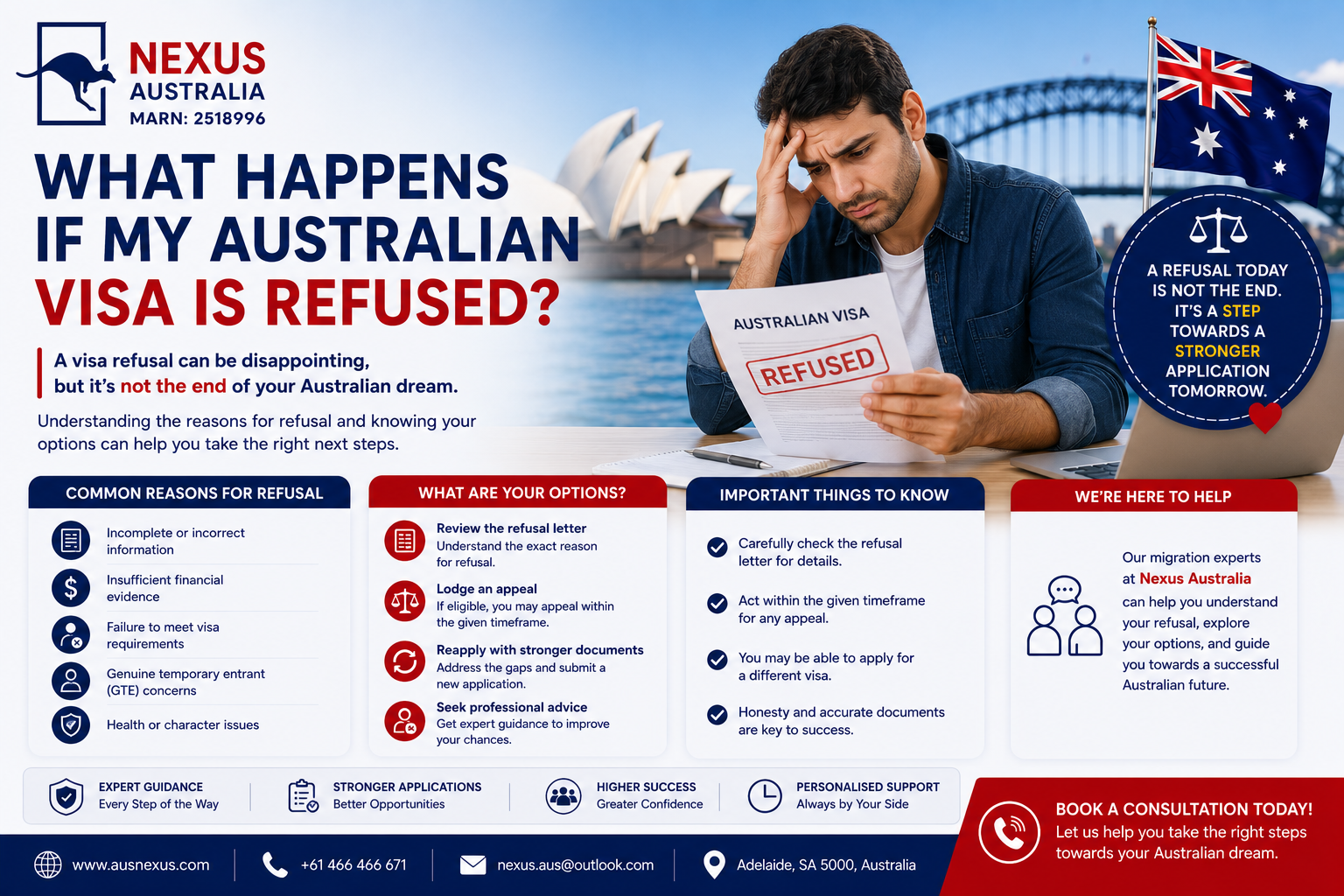
Australia remains one of the most sought-after destinations for skilled professionals, students, families, and business migrants. Every year, thousands of people submit visa applications hoping to study, work, live, or build a future in Australia.
While many applications are approved successfully, some applicants receive an outcome they were not expecting: a visa refusal. Receiving a refusal letter can be disappointing and stressful, especially after investing significant time, effort, and resources into the application process.
However, a visa refusal does not always mean your Australian dream is over. Understanding the reasons behind the refusal and knowing your available options can help you move forward strategically and confidently.
At Nexus Australia Visa- Adelaide, we help applicants understand refusal decisions, explore review options, and develop stronger visa strategies for future applications.
What Does an Australian Visa Refusal Mean?
A visa refusal occurs when the Australian Department of Home Affairs determines that an applicant has not met one or more visa requirements.
Immigration officers carefully assess every application against legislative requirements, supporting evidence, eligibility criteria, and immigration policies before making a decision.
If an applicant does not satisfy all requirements, the application may be refused. The refusal notice usually explains the reasons for the decision and may outline available review rights.
Understanding the refusal grounds is the first and most important step toward identifying the best path forward.
Why Are Australian Visas Refused?
Visa refusals can occur for many different reasons depending on the visa category and applicant circumstances.
One of the most common causes is incomplete or incorrect documentation. Missing information, outdated documents, or inconsistencies within an application can raise concerns during assessment.
Another common reason is failing to meet eligibility requirements such as skills, financial capacity, English language standards, sponsorship obligations, or relationship evidence.
In some situations, health or character requirements may also affect visa outcomes.
Insufficient Supporting Documents
Strong documentation is essential for every Australian visa application.
Immigration officers rely heavily on supporting evidence when assessing whether an applicant satisfies visa requirements.
If important documents are missing or unclear, decision-makers may be unable to verify key claims made within the application.
Providing complete, accurate, and well-organized documentation significantly improves the chances of a positive outcome.
Incorrect Information in Applications
Accuracy is critical during the visa application process.
Even small mistakes involving personal details, employment history, education records, or travel history can create complications.
Inconsistencies between forms and supporting documents may cause immigration officers to question the reliability of the information provided.
Carefully reviewing applications before submission can help prevent avoidable refusals.
Health and Character Requirements
Australia requires applicants to meet specific health and character standards.
Medical examinations help determine whether applicants satisfy Australia’s health requirements and do not create significant public health concerns.
Character assessments often involve police clearance certificates and background checks from countries where applicants have lived.
Failure to meet these requirements may result in visa refusal depending on individual circumstances.
Genuine Temporary Entrant Concerns
For certain temporary visas, immigration authorities assess whether applicants genuinely intend to comply with visa conditions.
If decision-makers are not satisfied that the applicant meets these expectations, concerns may arise during processing.
This is particularly relevant for student visas and some temporary visa categories.
Providing clear evidence and well-prepared supporting documents can help address these concerns effectively.
What Happens After a Visa Refusal?
After a refusal decision is issued, applicants receive an official notification explaining the outcome.
The refusal letter generally outlines the reasons behind the decision and may include information regarding review rights or available next steps.
Applicants should read this document carefully because it contains important details that may affect future actions.
Understanding exactly why the visa was refused helps determine the most appropriate response strategy.
Can a Visa Refusal Affect Future Applications?
Yes, a visa refusal can influence future Australian visa applications.
Immigration authorities maintain records of previous applications and decisions. Future applications may be assessed in light of past immigration history.
However, a refusal does not automatically prevent future visa approval.
Many applicants successfully obtain Australian visas after addressing the issues that caused the original refusal.
Is an Appeal Possible?
Some visa refusals may allow applicants to seek a review of the decision through the appropriate review process.
The availability of review rights depends on factors such as visa category, application circumstances, and location of the applicant at the time of decision.
A review authority may reassess the case and determine whether the original decision should be upheld or changed.
Strict deadlines often apply, making timely action extremely important.
Reapplying After a Visa Refusal
In many situations, applicants choose to submit a new application after a refusal.
A successful reapplication typically involves correcting the issues identified in the refusal decision and strengthening supporting evidence.
Simply submitting the same information again without addressing previous concerns may result in another refusal.
A strategic and well-prepared approach significantly improves future application prospects.
Common Mistakes to Avoid After Refusal
Many applicants make the mistake of immediately reapplying without understanding why the first application failed.
Others overlook important refusal details and continue using the same documentation that contributed to the original outcome.
Emotional decisions often lead to rushed applications and repeated mistakes.
Taking time to analyze the refusal properly can help create a stronger strategy moving forward.
The Importance of Professional Advice
Australian immigration laws can be complex and constantly evolving.
Understanding refusal reasons, review options, eligibility requirements, and future pathways often requires detailed knowledge of immigration regulations.
Professional migration guidance can help applicants identify weaknesses, strengthen evidence, and avoid repeating previous mistakes.
Expert support can also provide clarity during what is often a stressful and uncertain period.
How to Strengthen a Future Application
A stronger future application begins with understanding exactly what caused the refusal.
Applicants should focus on improving documentation quality, providing additional evidence, and ensuring all eligibility requirements are clearly demonstrated.
Accurate information, strong supporting documents, and a well-structured application can significantly improve approval prospects.
Careful preparation is often the difference between another refusal and a successful outcome.
The Role of Documentation in Visa Success
Documentation remains one of the most important aspects of any Australian visa application.
Employment records, financial evidence, educational qualifications, relationship documentation, health assessments, and police clearances all play important roles.
Each document should support the claims made within the application clearly and consistently.
Strong evidence helps immigration officers make informed decisions with greater confidence.
Why Preparation Matters More Than Ever
Competition for certain visa categories continues to increase as more people seek opportunities in Australia.
As a result, immigration authorities place greater emphasis on accuracy, compliance, and supporting evidence during assessments.
Well-prepared applications demonstrate credibility and reduce the likelihood of avoidable complications.
Investing time in preparation can save significant stress later in the process.
How Nexus Australia Visa- Adelaide Can Help
At Nexus Australia Visa- Adelaide, we understand how frustrating a visa refusal can be.
Our experienced migration team helps applicants review refusal decisions, identify weaknesses, and develop effective strategies for future applications.
We provide support across skilled migration, student visas, partner visas, employer-sponsored visas, and permanent residency pathways.
Our goal is to help clients move forward with confidence through accurate advice, strategic planning, and professional migration assistance.
Why Choose Nexus Australia Visa- Adelaide?
Navigating Australian immigration requirements alone can be challenging, particularly after receiving a refusal decision.
At Nexus Australia Visa- Adelaide, we provide personalized migration solutions tailored to each client’s circumstances and goals.
Our team focuses on clear communication, thorough preparation, and practical strategies designed to improve application outcomes.
We are committed to helping clients pursue their Australian migration goals with confidence and clarity.
Final Thoughts
A visa refusal can be disappointing, but it does not always mark the end of your Australian migration plans.
Many refusals can be addressed through reviews, stronger documentation, improved eligibility evidence, or carefully planned future applications.
The most important step is understanding why the refusal occurred and taking informed action based on that information.
Visit Nexus Australia Visa- Adelaide today to receive professional guidance and expert support for your Australian visa journey.