
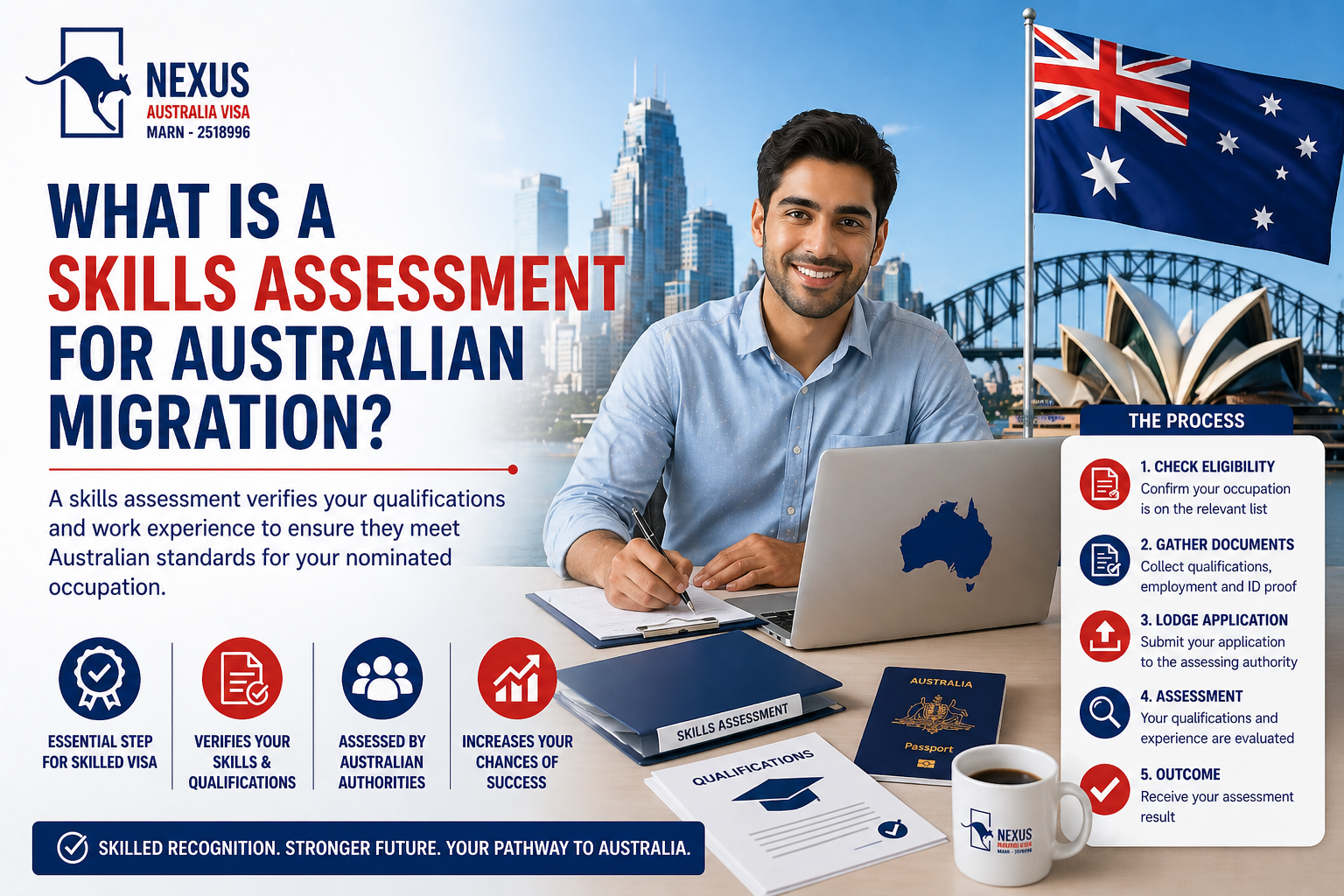
If you’ve started researching how to migrate to Australia as a skilled worker, you’ve almost certainly come across the term “skills assessment” and if you’re anything like most people at the beginning of this journey, you probably have a vague sense that it’s important without fully understanding what it actually involves or why it matters so much.
Here’s the short version: without a positive skills assessment, most skilled migration pathways to Australia simply don’t open for you. It’s not optional, it’s not a formality, and it’s not something you can work around. It’s a foundational requirement that sits at the very beginning of the skilled migration process and getting it right sets the tone for everything that follows.
This guide walks you through exactly what a skills assessment is, how it works, who conducts it, what you need to prepare, and what happens if things don’t go to plan. By the time you finish reading, you’ll have a genuinely clear picture of what’s involved and what you need to do next.
So What Exactly Is a Skills Assessment?
A skills assessment is a formal evaluation conducted by an approved Australian assessing authority that confirms two things: first, that your qualifications meet Australian professional standards for your nominated occupation, and second, that your work experience is genuine, relevant, and at the appropriate skill level.
Think of it as Australia’s way of verifying that what you bring to the table professionally is real, credible, and comparable to what a locally trained worker in the same role would offer. It’s not about doubting your credentials it’s about ensuring consistency and maintaining the integrity of Australia’s skilled workforce across all the different countries and education systems that migrants come from.
The outcome of your skills assessment positive or negative directly determines whether you can proceed with a skilled visa application. A positive assessment confirms you’re eligible to nominate that occupation for migration purposes. A negative assessment means you either need to challenge the outcome, submit additional evidence, or reconsider your nominated occupation entirely.
Why Is It Mandatory?
Australia’s skilled migration program is built around the idea of matching overseas talent with genuine gaps in the local labour market. To do that effectively, the system needs confidence that applicants genuinely have the skills they claim not just on paper, but in practice.
Without a mandatory skills assessment, the system would be wide open to applicants nominating occupations they have little genuine experience in simply because those occupations attract more migration points or appear on a favourable list. The assessment process closes that gap by requiring independent verification from a recognised professional body before anyone enters the SkillSelect pool.
It also protects Australian employers and industries. When a skilled migrant arrives claiming a particular professional background, their skills assessment provides a level of assurance that their qualifications and experience have been independently checked against Australian standards not just self-declared on a form.
When Do You Need to Complete It?
The skills assessment must be completed and receive a positive outcome before you can submit your Expression of Interest (EOI) through SkillSelect. This is a critical sequencing point that many first-time applicants get wrong they assume the assessment can happen concurrently with or after the EOI submission, and that’s simply not how the process works.
Your positive skills assessment is a prerequisite for the EOI, and the EOI is a prerequisite for receiving an invitation to apply for a skilled visa. So if your assessment is delayed, your entire timeline shifts. If it comes back negative and needs to be resubmitted, that delay compounds. Starting the skills assessment process as early as possible in your migration journey is one of the most impactful decisions you can make for your overall timeline.
💡 Not sure which skills assessment body applies to your occupation or how to prepare your submission? The team at Nexus Australia guides skilled migrants through the assessment process every day helping clients gather the right evidence, format their submissions correctly, and avoid the common mistakes that lead to delays or negative outcomes. Led by MARA-registered agent Mandeep Gill (MARN: 2518996), Nexus offers a completely free initial case evaluation. Visit ausnexus.com or WhatsApp +61 466 466 671 to get started.
Which Authority Assesses Your Skills?
This is where it gets specific and where a lot of applicants run into confusion. There isn’t a single body that conducts all skills assessments. Instead, different occupations are assigned to different assessing authorities, each with its own application process, documentation requirements, fee structure, and processing timeframe.
Here’s a look at some of the most commonly referenced assessing bodies and the occupations they cover:
Engineers Australia assesses engineers across all disciplines civil, mechanical, electrical, structural, and more. Their assessment process is known for being thorough and detailed, requiring not just qualification documents but also a Competency Demonstration Report (CDR) that describes your engineering work in narrative form against specific competency elements.
Australian Computer Society (ACS) handles skills assessments for IT and technology professionals. They assess a wide range of ICT occupations and have a relatively structured online application process, though the requirements for demonstrating relevant experience are still significant.
CPA Australia, Chartered Accountants Australia and New Zealand (CAANZ), and IPA all assess accounting professionals, with different membership pathways depending on your specific accounting background and qualifications.
Australian Health Practitioner Regulation Agency (AHPRA) manages registration and assessment for a wide range of healthcare professionals including nurses, doctors, physiotherapists, psychologists, and more. Healthcare assessments often run parallel to registration processes rather than as a completely separate step.
VETASSESS is one of the broadest assessing authorities, covering a large number of professional, technical, and trade occupations that don’t fall under a more specific body. If your occupation isn’t covered by one of the specialist bodies, VETASSESS is often the relevant authority.
Trades Recognition Australia (TRA) assesses trade occupations electricians, plumbers, carpenters, chefs, automotive technicians, and similar skilled trades. Their process often involves not just document review but practical skills evaluation in some cases.
Knowing which body applies to your occupation is step one. And getting that right matters more than most people initially realise nominating the wrong assessing authority can mean your application goes to the wrong body entirely, causing delays and potentially additional costs.
What Do They Actually Assess?
While each authority has its own specific process and requirements, most skills assessments evaluate two core things: your formal qualifications and your work experience.
On the qualifications side, assessors look at where you studied, what qualification you hold, whether it’s comparable to the Australian equivalent for your occupation, and in some cases whether it was completed at an institution recognised by the assessing body. International qualifications are measured against the Australian Qualifications Framework (AQF) to determine equivalency.
On the work experience side, assessors look at how many years of relevant skilled employment you have, whether your roles genuinely required the skills of your nominated occupation at the appropriate level, and whether your employment can be independently verified. This is typically where the documentary evidence requirements become most demanding assessors don’t just take your word for it.
What Documents Do You Typically Need?
While documentation requirements vary between assessing bodies, there’s a core set of documents that most assessments require in some form. Being organised with these from the start saves significant time and reduces the risk of your assessment being delayed due to missing information.
Academic transcripts and certificates are fundamental certified copies of your degree, diploma, or trade qualification, along with official transcripts showing the subjects you studied. If these are not in English, certified translations will be required.
Employment references and letters are critical for demonstrating your work experience. These need to come from employers or supervisors on official letterhead, typically specifying your job title, employment dates, key duties, and hours worked. Vague or informal references are one of the most common reasons assessments are delayed or questioned.
A current resume or curriculum vitae outlining your full employment history, education, and relevant professional achievements is almost always required as a supporting document.
Proof of identity passport copies, birth certificates, or similar identification documents is standard across all assessing bodies.
Membership certificates or professional registrations from relevant bodies in your home country can strengthen your submission, particularly for regulated professions.
For bodies like Engineers Australia, there are additional narrative requirements the Competency Demonstration Report that go well beyond simple document submission and require careful, structured writing against defined competency standards. These can take weeks to prepare properly and are commonly the stage where applicants most benefit from professional support.
💡 Preparing a skills assessment submission is more involved than most people expect and the quality of your documentation genuinely affects the outcome. The team at Nexus Australia has extensive experience helping applicants across a wide range of occupations prepare compelling, complete skills assessment submissions. Don’t risk a negative outcome through avoidable gaps in your evidence. Visit ausnexus.com or call +61 466 466 671 to speak with the Nexus team today.
How Long Does a Skills Assessment Take?
Processing times vary considerably depending on which assessing body is handling your application, how complete your submission is, and how busy the authority is at the time you apply. As a rough guide:
VETASSESS professional occupations typically process within 12 to 16 weeks, though this can extend during peak periods. ACS assessments for IT professionals generally take around 6 to 8 weeks for standard applications. Engineers Australia CDR-based assessments can take 12 to 16 weeks or longer depending on the stream. TRA trade assessments vary widely and can take several months, particularly if a practical skills evaluation is required.
These timeframes assume your application is complete and well-prepared from the start. Incomplete submissions, missing documents, or requests for additional information can add weeks or months to the process. This is another reason why beginning early and submitting a thorough, well-organised application matters so much.
What Happens If Your Assessment Comes Back Negative?
A negative skills assessment is disappointing but it’s not necessarily the end of the road. Understanding why the negative outcome occurred is the critical first step. Most assessing authorities provide a reason for their decision, and that reason determines what your options are.
In some cases, the issue is simply insufficient documentation the assessor didn’t have enough evidence to make a positive determination, and submitting additional supporting material in a review or reapplication can resolve the problem. In other cases, the qualifications or work experience genuinely don’t meet the required standard for the nominated occupation, and the more strategic response is to consider an alternative occupation code that better fits your actual background.
Some assessing bodies have formal review or appeal mechanisms that allow you to challenge a negative outcome if you believe the decision was incorrect or that relevant evidence wasn’t properly considered. These processes have strict timeframes, so acting quickly after receiving a negative result is important.
This is precisely where having a migration professional in your corner makes an enormous difference. Understanding the specific reason for a negative outcome, evaluating the realistic options available, and deciding on the most effective next step requires both migration law knowledge and familiarity with how assessing authorities operate which is exactly what an experienced registered migration agent brings to the table.
Common Mistakes That Lead to Problems
After years of helping skilled migrants through this process, certain patterns emerge in what goes wrong. Being aware of them upfront can save you significant time, money, and frustration.
Choosing the wrong occupation code is perhaps the most consequential mistake. Your nominated occupation must accurately reflect your actual qualifications and work experience not what you wish you could claim. Nominating an occupation that sounds close but doesn’t genuinely match your background often results in a negative assessment and wasted time.
Underestimating the employment reference requirements is extremely common. Many applicants submit references that are too brief, too informal, or missing key details like specific duties, hours worked, or the employer’s contact information. Assessors need to be able to verify your employment, and a poorly written reference raises questions rather than answering them.
Leaving it too late is a timing mistake that cascades through the entire migration timeline. If you start your skills assessment only after you’re ready to lodge your EOI, you’ve already introduced a delay of several months into a process where timing often matters enormously.
Not seeking professional guidance for complex cases particularly for bodies like Engineers Australia that require narrative writing against competency standards leads to submissions that don’t represent the applicant’s genuine capabilities effectively.
How a Skills Assessment Fits Into the Bigger Migration Picture
It helps to see the skills assessment not as a standalone hurdle but as the first step in a logical sequence. A positive assessment allows you to enter SkillSelect. A strong SkillSelect profile built on good points, a well-chosen occupation, and accurate documentation earns you an invitation. An invitation lets you lodge your actual visa application. And a well-prepared visa application leads to a grant.
Every step in that chain matters, and the skills assessment is where the chain begins. Getting it right choosing the right occupation, the right assessing body, submitting thorough and well-organised documentation sets a positive foundation for everything that follows. Getting it wrong, or rushing it, can introduce complications and delays that ripple through your entire migration journey.
💡 Nexus Australia supports skilled migrants at every stage of this process from choosing the right occupation code and assessing body through to visa lodgement and beyond. Based in Adelaide’s CBD with support offices in India and Canada, the team is genuinely accessible no matter where in the world you’re currently located. Founder and lead agent Mandeep Gill brings meticulous attention to detail, deep migration law expertise, and genuine personal commitment to every client she works with. Visit ausnexus.com, email info@ausnexus.com, or WhatsApp +61 466 466 671 – your free case evaluation is waiting.
Final Thoughts – Start Early, Prepare Thoroughly, Get It Right
The skills assessment is one of the most important steps in your Australian migration journey, and it deserves to be treated that way. It’s not a box-ticking exercise it’s a substantive professional evaluation that requires proper preparation, the right documentation, and a clear understanding of what the assessing authority is actually looking for.
Start the process as early as you possibly can. Research which assessing body applies to your occupation before you do anything else. Gather your employment references, academic documents, and certifications in the right format from the beginning. And if your occupation involves a more complex assessment process or if you’re unsure about any aspect of what’s required don’t hesitate to seek professional guidance.
The skills assessment is your entry point into the Australian skilled migration system. Approach it with the seriousness it deserves, and you’ll be starting your migration journey from the strongest possible foundation.
Ready to begin your skills assessment journey with expert support behind you? Contact the team at Nexus Australia today. Call +61 466 466 671, WhatsApp “VISA”, or visit ausnexus.com your case evaluation starts the conversation that could change your life.