An Honest Comparison to Help You Decide
Here’s a question that comes up constantly among skilled migrants preparing for their Australian PR journey which English test should I actually sit? IELTS or PTE? And does it even matter which one I choose?
The honest answer is that both tests are equally valid for Australian migration purposes. The Department of Home Affairs accepts scores from either, and a Proficient English result on PTE carries exactly the same weight as a Proficient English result on IELTS when your migration points are being calculated. So in the strictest technical sense, neither test is objectively “better” than the other for PR purposes.
But and this is the part that actually matters for your personal decision the two tests are very different in how they work, how they feel to sit, how quickly you get your results, and which one tends to suit different types of test takers. Choosing the right one for your specific situation can genuinely affect your score, your timeline, and ultimately your migration outcome. So let’s break it down properly.
First, Why Does Your English Test Even Matter So Much?
Before comparing the two tests, it’s worth stepping back and understanding why this decision carries so much weight in the Australian PR process. English proficiency isn’t just a checkbox for visa eligibility it’s also one of the most impactful point-earning categories in Australia’s skilled migration points test.
Meeting the minimum standard of Competent English (roughly IELTS 6.0 or PTE 50 in each component) makes you eligible to apply, but it doesn’t earn you any bonus migration points. Step up to Proficient English (IELTS 7.0 overall or PTE 65) and you pick up an additional 10 points. Reach Superior English (IELTS 8.0 overall or PTE 79) and that jumps to 20 bonus points added to your score.
In a competitive SkillSelect environment where the difference between receiving an invitation and waiting another 12 months can come down to just a handful of points, those 10 or 20 extra points are genuinely significant. Choosing the test you’re most likely to score highest on not just the one you’ve heard of most is therefore a strategic migration decision, not just an administrative one.
IELTS – The Globally Recognised Standard
The International English Language Testing System (IELTS) has been around since 1989 and remains one of the most widely recognised English language tests in the world. For Australian migration, the IELTS Academic version is typically required for skilled migration visas, though the General Training version is accepted for some visa categories.
IELTS assesses four skills: Listening, Reading, Writing, and Speaking. Each section is scored on a band scale from 1 to 9, and your overall band score is the average of all four components rounded to the nearest half band. For Australian migration, you generally need scores in each individual band not just the overall average to meet the relevant English proficiency level.
One of the defining features of IELTS is that the Speaking test is conducted face-to-face with a human examiner. For many test takers, this feels more natural and comfortable than speaking to a computer it allows for genuine conversational flow, the ability to ask for clarification, and a more human interaction overall. For people who feel anxious speaking to machines or who express themselves better in real conversation, this can be a meaningful advantage.
What IELTS Does Well
IELTS is accepted not just for Australian migration but for immigration purposes in the UK, Canada, New Zealand, and dozens of other countries, as well as for university admission around the world. If you’re keeping your options open between multiple countries or combining a university application with a migration plan, IELTS’s global recognition makes it an incredibly versatile result to have in your back pocket.
The test is also widely available IELTS test centres exist in virtually every major city around the world, and test dates are offered frequently throughout the year. In many locations, you can sit the test on paper or on a computer, giving you some flexibility in how you engage with the material.
Results for the computer-delivered version of IELTS are typically available within 3 to 5 business days, while the paper-based version takes around 13 days. For applicants who need results quickly, the computer-delivered option is definitely the smarter choice.
Where IELTS Can Be Challenging
For some test takers, IELTS writing tasks can feel more demanding particularly the Academic version, which requires essay and report writing that not everyone finds intuitive. The reading passages can also be dense and time-pressured, and the paper-based format requires strong handwriting speed for written responses.
Scoring consistency has also been a topic of discussion among test takers over the years because human examiners mark the Writing and Speaking components, there’s a degree of subjectivity involved. Most people find examiners to be fair and professional, but the subjective element is worth acknowledging.
💡 Not sure which English test aligns best with your migration goals and points target? The team at Nexus Australia helps skilled migrants make smart, strategic decisions about every aspect of their PR journey including which English test to sit and when. Led by MARA-registered agent Mandeep Gill (MARN: 2518996), Nexus offers a completely initial case evaluation. Visit ausnexus.com or WhatsApp +61 466 466 671 to get personalised guidance today.
PTE Academic – The Modern, Computer-Based Alternative
Pearson Test of English Academic (PTE Academic) is a fully computer-based English test that has grown enormously in popularity among Australian migration applicants over the past decade. It assesses the same four core skills Speaking, Writing, Reading, and Listening but the format, delivery, and experience are quite different from IELTS.
The biggest practical advantage that PTE is known for is its speed of results. In most cases, PTE Academic results are delivered within 24 to 48 hours of sitting the test sometimes even faster. For applicants who are working against a deadline, whether that’s a visa expiry, a state nomination round closing, or simply wanting to submit their EOI as quickly as possible, this turnaround time can be a genuine game-changer.
The entire test is conducted on a computer, including the Speaking component which means you speak your responses into a microphone rather than to a human examiner. The scoring is entirely AI-driven, which eliminates the subjective element that comes with human marking. For applicants who feel their English is strong but sometimes struggle with examiner nerves or the pressure of face-to-face assessment, the computer-based environment can actually be more comfortable and conducive to performing at their best.
What PTE Does Well
Alongside its speed of results, PTE is known for being highly consistent in its scoring because everything is AI-marked, you don’t have to worry about examiner variability on your Writing or Speaking sections. What you produce is assessed against a fixed algorithmic standard, which many test takers find reassuring.
PTE test centres are widely available across Australia and in most major international cities, and the test can be booked at relatively short notice sometimes within a few days. For applicants who want maximum flexibility in scheduling their test around work and study commitments, this accessibility is a real advantage.
Many applicants also report that PTE’s integrated task format where some questions test multiple skills simultaneously feels more natural and efficient once they’ve done proper preparation. The test moves quickly and rewards applicants who can think and respond fluently under time pressure.
Where PTE Can Be Challenging
The AI-based marking system that makes PTE so consistent can also make it less forgiving in specific ways. The Speaking section in particular rewards clear enunciation, appropriate pace, and fluent delivery and the AI can sometimes penalise hesitations, filler words, or pronunciation patterns that a human examiner might contextualise more generously.
The integrated task format also means that preparation for PTE requires familiarity with question types that are quite specific to this test. Applicants who walk in without proper PTE-specific preparation often find the format more disorienting than they expected, even if their English ability is genuinely strong. Understanding the test’s unique structure before sitting it is not optional it’s essential.
IELTS vs PTE – A Side-by-Side Comparison
To make the comparison as clear as possible, here’s how the two tests stack up across the key factors that matter most to Australian PR applicants:
Results speed: PTE wins decisively here 24 to 48 hours versus 3 to 13 days for IELTS depending on the format. For time-sensitive migration decisions, this difference is significant.
Speaking format: IELTS uses a human examiner in a face-to-face interview. PTE uses AI-based computer assessment. Which you prefer comes down entirely to your personality and how you perform under each type of condition.
Marking consistency: PTE’s fully AI-driven marking is highly consistent. IELTS Writing and Speaking involve human judgment, which introduces a small degree of variability though most examiners are highly trained and professional.
Global recognition: IELTS has broader international recognition across immigration, academia, and employment contexts worldwide. If you want one test result that works across multiple life goals studying, migrating, working professionally IELTS’s versatility is an advantage.
Preparation resources: Both tests have extensive preparation materials available. IELTS has a longer history and arguably more published practice resources, but PTE-specific preparation content has grown significantly in recent years and is now very widely available.
Test availability and booking flexibility: Both are widely available, but PTE’s frequent test dates and shorter advance booking windows give it a slight edge in flexibility.
Score validity: Both IELTS and PTE results are valid for three years for Australian migration purposes. After three years, you’ll need to resit the test if your result has expired.
💡 At Nexus Australia, the team helps clients understand not just which test to sit, but how their English score fits into their overall migration strategy including which score they need to hit for maximum points and how that interacts with their EOI timing. It’s the kind of joined-up thinking that makes a real difference to migration outcomes. Reach out at ausnexus.com or call +61 466 466 671 for your case evaluation.
What About TOEFL iBT and OET?
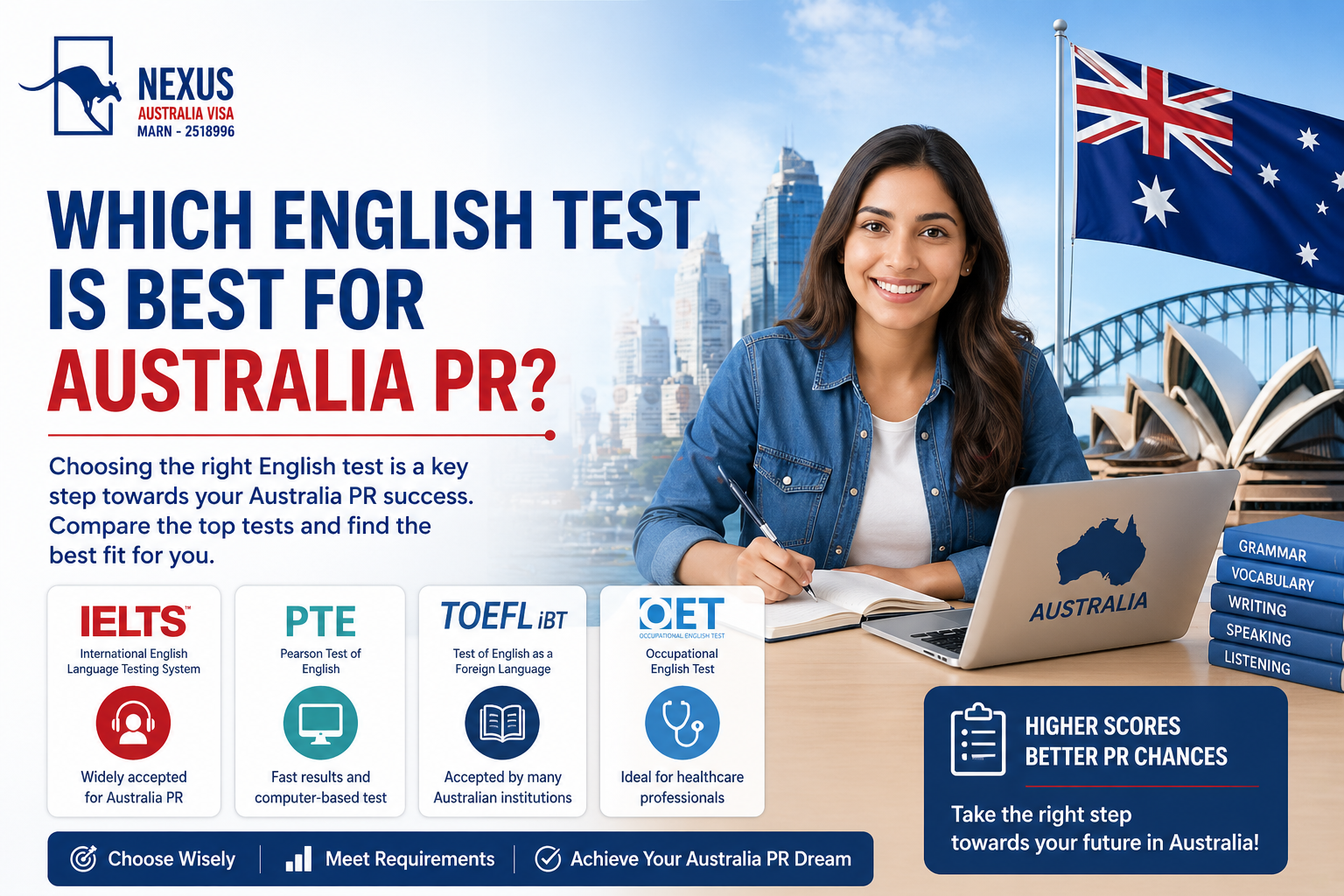
While IELTS and PTE are the most commonly used tests for Australian skilled migration, they’re not the only options. TOEFL iBT is also accepted for most skilled visas, though it’s less commonly chosen by migration applicants than the other two. It’s worth knowing it exists, particularly for applicants who have already sat TOEFL for university admission purposes.
OET (Occupational English Test) is specifically designed for healthcare professionals and is accepted for migration purposes by applicants in eligible healthcare occupations. If you’re a nurse, doctor, dentist, physiotherapist, or other regulated health professional, OET assesses your English in a clinical context which many healthcare workers find more relevant and natural than the general academic or everyday English tested by IELTS and PTE.
For most skilled migrants outside the healthcare field, IELTS and PTE remain the two most practical and strategically sensible choices and the decision between them really does come down to individual preference and circumstance rather than one being inherently superior.
So Which One Should You Actually Choose?
Here’s the practical framework that experienced migration professionals use when helping clients make this decision. It’s not about which test is objectively better it’s about which one is better for you specifically.
Choose PTE Academic if you need your results quickly and your migration timeline is time-sensitive. If you’re comfortable with computer-based testing, prefer AI consistency over human marking, and feel confident speaking fluently into a microphone, PTE is often the smarter tactical choice for Australian migration.
Choose IELTS if you prefer the face-to-face Speaking interaction with a human examiner and feel you perform better in that environment. If you’re also planning to use your English test result for purposes beyond Australian migration university admission in another country, immigration to the UK or Canada IELTS’s broader recognition gives it additional value.
In both cases, proper test-specific preparation is non-negotiable. Sitting either test cold without familiarising yourself with the question types, timing, and format is one of the most avoidable ways to underperform. Practice materials, mock tests, and targeted coaching for your weaker skill areas are worth the investment, especially when the difference between Proficient and Superior English is worth 10 migration points.
One More Thing – Timing Your Test Strategically
Beyond which test you choose, when you sit it matters too. Your English test result is valid for three years, so sitting it too early before you’re ready to progress with your migration means it could expire before your visa is granted, requiring you to resit.
On the other hand, waiting too long to sit your test delays your ability to submit an EOI, which delays everything downstream. The ideal timing depends on where you are in your overall migration journey which is yet another reason why having a clear, personalised migration roadmap in place before you make these decisions is so valuable.
💡 Nexus Australia works with skilled migrants at every stage of their PR journey from choosing the right English test and setting a realistic score target, through to EOI strategy, state nomination, and visa lodgement. Based in Adelaide’s CBD with support offices in India and Canada, the team is genuinely accessible wherever in the world you’re currently located. MARA agent Mandeep Gill and the Nexus team bring deep expertise and genuine personal commitment to every client they work with. Visit ausnexus.com, email info@ausnexus.com, or WhatsApp +61 466 466 671 your case evaluation is just one conversation away.
Final Thoughts – The Test Matters Less Than Your Score
At the end of the day, the most important thing isn’t whether you choose IELTS or PTE it’s what score you achieve. A Superior English result on either test adds the same 20 points to your migration score. A Proficient result on either adds the same 10 points. The test is just the vehicle. Your score is what actually moves your migration forward.
So choose the test you’re most likely to perform best on, prepare for it properly and thoroughly, and go in with a clear target score in mind based on what your migration strategy actually needs. That combination the right test, the right preparation, and the right score target is what turns your English test from a box-ticking exercise into a genuine strategic asset in your Australian PR journey.
Want to know exactly which English score you need for your specific migration pathway and how it fits into your overall points strategy? Speak with the team at Nexus Australia today. Call +61 466 466 671, WhatsApp “VISA”, or visit ausnexus.com your case evaluation gives you clarity, direction, and a plan that actually works.