
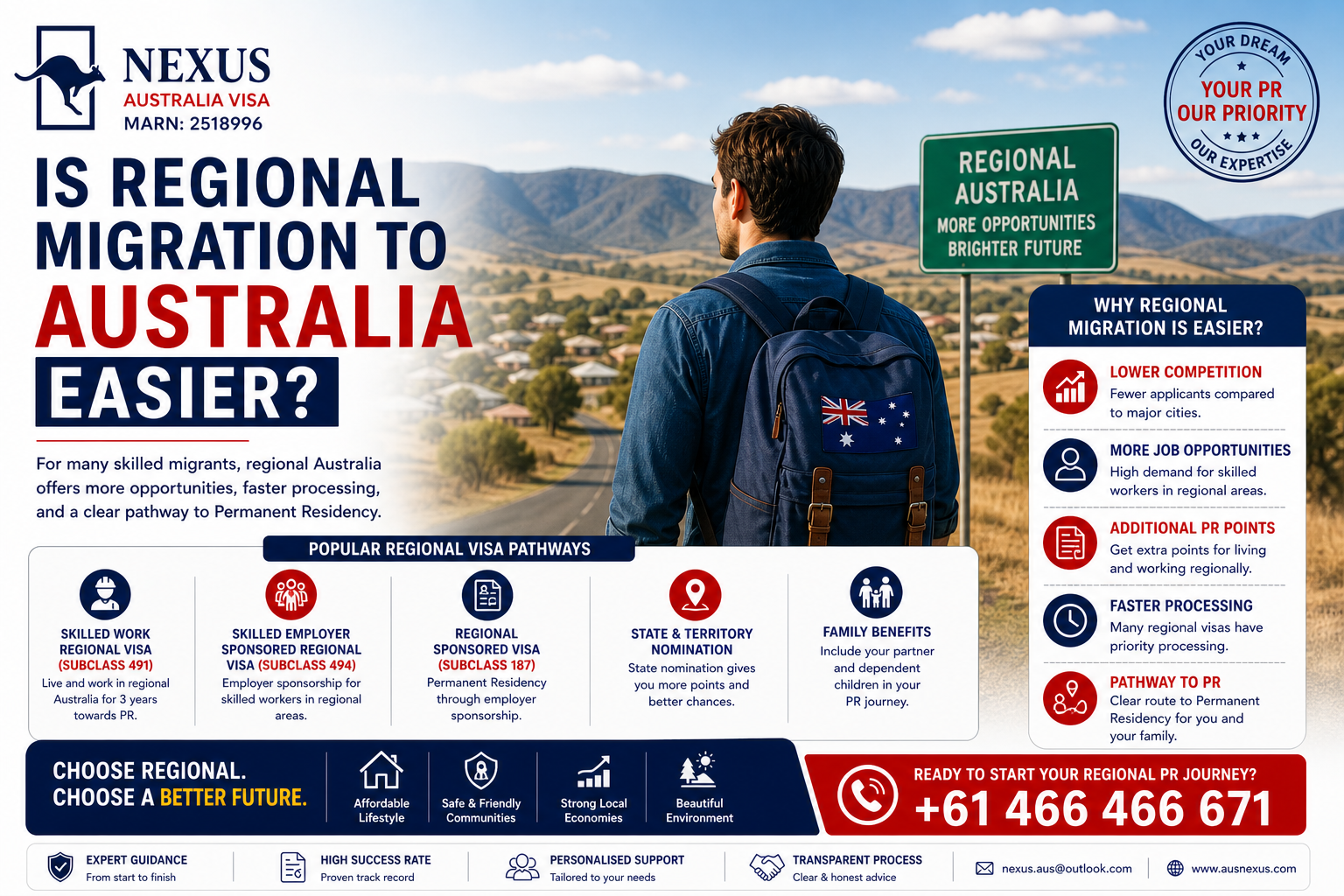
The Question Every Skilled Migrant Is Asking
If you have been exploring your options to migrate to Australia, you have likely come across the term “regional migration” more than once. It sounds appealing — but is regional migration to Australia actually easier than the standard pathway? The short and honest answer is: in many cases, yes. Regional migration opens doors that the traditional skilled migration route may keep firmly closed.
Australia’s regional migration framework is not just a backup option it is a strategically designed pathway that rewards migrants who are willing to settle outside the hustle of Sydney, Melbourne, and Brisbane. From extra points to a broader list of eligible occupations, regional migration offers real and measurable advantages that can make your Australian dream much more achievable.
What Is Regional Migration in Australia?
Regional migration refers to visa pathways that require applicants to live and work in designated regional areas of Australia. These areas are typically outside the major metropolitan cities and include places like South Australia, Queensland’s regional zones, Western Australia, and many more. The Australian government actively promotes these pathways to distribute the population growth and economic benefit across the entire country.
Rather than competing in a highly competitive metro-focused pool, regional migration lets skilled workers tap into a system specifically tailored to welcome them. It is a win-win — migrants gain a clearer path to permanent residency, and regional communities gain the skilled workforce they desperately need. This mutual benefit is exactly why the system is designed to be more accessible.
The Points Advantage: Why Regional Migration Gives You an Edge
One of the most compelling reasons to consider regional migration is the additional points it provides under Australia’s points-tested visa system. The Skilled Independent visa (subclass 189) requires applicants to compete purely on points, making it incredibly tough for many skilled workers. Regional visa pathways, however, provide bonus points that can significantly boost your Expression of Interest (EOI) score.
Applicants who nominate a regional area can receive up to 15 additional points on their SkillSelect profile. In a highly competitive points-based system, those extra points can be the difference between receiving an invitation and waiting indefinitely. At Nexus Australia, our expert MARA-registered agents help you understand exactly how these points apply to your profile and how to position yourself for success.
Broader Occupation Lists: More People Qualify
Another major advantage of regional migration is the broader scope of eligible occupations. The metro-focused Skilled Independent visa (subclass 189) uses a relatively narrow skills list, which means many professionals simply do not qualify through that route. Regional visas, particularly the subclass 491 and 494, draw from much more expansive occupation lists.
This means nurses, tradespeople, educators, accountants, IT professionals, engineers, and a wide range of other skilled workers may find their occupation included under regional pathways — even if it does not appear on the standard skilled migration list. The regional occupation lists are reviewed and updated regularly to reflect the genuine needs of communities across Australia. If your occupation has previously left you feeling stuck, regional migration may be the fresh opportunity you have been waiting for.
Priority Processing: Move Faster Through the System
Time is one of the most stressful elements of any visa journey, and regional migration addresses this directly through priority processing. Visa applications lodged under regional migration pathways are generally processed faster than many standard skilled migration applications. The Australian government treats regional applications with a higher level of urgency, reflecting the country’s strong commitment to growing its regional economies.
For skilled migrants who are eager to build their lives in Australia without enduring years on a waiting list, this is a significant advantage. Faster processing means less uncertainty, less time in limbo, and more time doing what truly matters — building your career and your family’s future in Australia. The team at Nexus Australia understands how crucial timelines are and works to ensure your application is prepared and lodged with precision.
Key Regional Visa Pathways to Know
There are two primary regional visa subclasses that most skilled migrants will encounter on this journey. The first is the Skilled Work Regional (Provisional) visa — subclass 491. This visa is for workers nominated by a state or territory government, or sponsored by an eligible family member in a regional area. It is a provisional visa with a pathway to permanent residency after three years.
The second is the Employer Sponsored Regional (Provisional) visa subclass 494. This visa is for skilled workers sponsored by an approved employer in a regional area of Australia. Both of these visas lead to the Subclass 191 Permanent Residence (Skilled Regional) visa, which grants you the right to live and work permanently anywhere in Australia. Understanding which pathway suits your profile is something the experienced consultants at Nexus Australia specialise in.
State and Territory Nomination: Your Gateway to Regional Visas
A critical component of many regional visa pathways is state or territory nomination. Each Australian state and territory manages its own regional migration program, and nominations are granted based on local skills shortages, economic needs, and individual applicant profiles. Getting a state nomination is a strategic process — it is not simply about applying and hoping for the best.
Different states have different requirements, invitation rounds, and occupation priorities. South Australia, for example, is known for its welcoming approach to skilled migrants and has a strong regional migration program. Nexus Australia, based in Adelaide, has deep expertise in South Australian migration pathways and can guide you through the nomination process from start to finish. Knowing which state to target and when is often what separates successful applicants from those who wait.
Life Outside the Big Cities: Is It Worth It?
Many migrants initially hesitate at the idea of settling in a regional area, imagining remote outback towns far from conveniences. The reality, however, is quite different. Regional Australia includes thriving cities like Adelaide, Darwin, Hobart, and Canberra, as well as vibrant towns with strong communities, excellent schools, healthcare facilities, and growing job markets.
The quality of life in regional Australia is consistently ranked among the best in the world. Lower cost of living, shorter commutes, cleaner environments, and tighter-knit communities are just some of the lifestyle advantages that regional living offers. Many migrants who initially chose regional pathways out of necessity have stayed by choice — because they genuinely fell in love with the lifestyle. Australia is not just one of the most liveable countries globally; its regional areas often represent some of its finest living experiences.
How Nexus Australia Helps You Navigate Regional Migration
Navigating Australia’s complex migration system without professional guidance is a risk no applicant should take. The difference between a well-prepared application and a poorly structured one can mean years of delay or even visa refusals. Nexus Australia is Adelaide’s premier migration agency, staffed by MARA-registered agents who bring deep expertise and genuine care to every case.
From your very first free case evaluation to the final grant of your visa, Nexus Australia provides comprehensive, personalised support at every step of the journey. Whether you are exploring the subclass 491, the subclass 494, or employer-sponsored pathways, the Nexus team has the knowledge and experience to guide you with confidence. Think Australia, Think Nexus — because your future deserves the best possible start.
Common Myths About Regional Migration — Debunked
Myth 1: Regional migration means living in the middle of nowhere. Not true. Many regional visa holders live comfortably in cities like Adelaide, which is a sophisticated, culturally rich metropolitan hub with world-class amenities and a thriving international community.
Myth 2: Regional visas don’t lead to permanent residency. Completely false. The regional pathway is a well-defined route to permanent residency through the subclass 191 visa, provided you meet the work and residency requirements over three years.
Myth 3: Regional migration is only for low-skilled workers. Incorrect. Regional occupation lists include high-skilled professionals across engineering, healthcare, IT, finance, education, and many more industries. The pathway is open to a wide range of skilled migrants.
Final Thoughts: Is Regional Migration Your Smartest Move?
If you are a skilled migrant looking to make Australia your home, regional migration deserves serious consideration. The additional points, broader occupation eligibility, priority processing, and clear pathway to permanent residency make it one of the most accessible and rewarding routes available today. It is a system designed not to disadvantage you — but to actively invite you in.
The key is to approach this journey with the right information and the right guidance by your side. Nexus Australia is here to ensure that every decision you make is informed, strategic, and aligned with your long-term goals. Reach out today for your free case evaluation and take the first confident step toward your Australian future.
📍 Nexus Australia | Leading Migration Agents in Adelaide 🌐 www.ausnexus.com 💬 Chat with us on WhatsApp | Case Evaluation Available
Think Australia. Think Nexus.